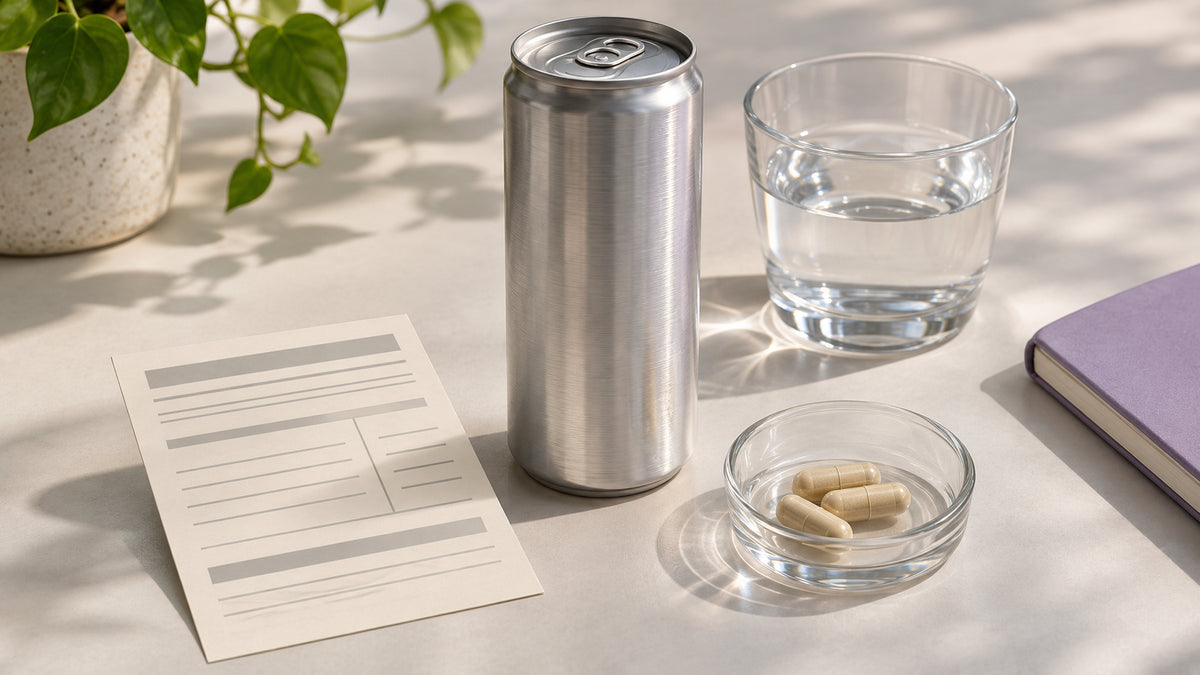
Can you take a multivitamin with an energy drink? There is no answer that covers every combination. Check the full drink volume, the multivitamin’s recommended daily serving and any overlapping ingredients. A nutrition panel showing amounts “per 100 ml” is not showing the total in a larger can.
This guide walks through that calculation using a real UK drink label, then separates vitamin totals from caffeine. It helps you prepare a useful label check; it does not establish that a particular combination is safe for you.
Start with the whole can, not the front-of-pack message
Look for three details: the can’s volume, whether the nutrition panel is per 100 ml or per can, and the amount you actually drink. A 250 ml can contains 2.5 lots of 100 ml. A 500 ml can contains five.
Whole-can amount = amount per 100 ml × can volume in ml ÷ 100.
If a label already gives an amount per can, use that figure directly. Multiplying it again would count the drink twice. Check each heading: caffeine can be stated on a different basis from the vitamin table.
A UK label example: vitamin B6 per can
Red Bull’s official UK ingredients page, checked on 9 November 2026, lists the following vitamins per 100 ml for its original Energy Drink. The right-hand column is our calculation for one 250 ml can.
| Vitamin | Per 100 ml | Per 250 ml can |
|---|---|---|
| Niacin (B3) | 8 mg | 20 mg |
| Pantothenic acid (B5) | 2 mg | 5 mg |
| Vitamin B6 | 2 mg | 5 mg |
| Vitamin B12 | 2 µg | 5 µg |
Source: Red Bull’s UK ingredients and nutrition declaration. Check the can in your hand: sizes, recipes, flavours and country-specific products can differ, and online information can change.
The B6 calculation is 2 mg × 2.5 = 5 mg. Reading only the “2 mg” row would miss more than half the amount in that 250 ml can. Using the same concentration for a hypothetical 500 ml drink gives 10 mg, but do not assume another product has that concentration.
Then add the multivitamin’s daily serving
Find the nutrient panel on your multivitamin. Does it show amounts per capsule or per recommended daily serving? If the panel is already per two-capsule serving and the directions say two daily, that listed amount is the daily total. Do not double it again.
For an illustrative calculation only, imagine a multivitamin providing 2 mg of B6 in its full daily serving. Combine that with 5 mg from the drink example and the subtotal is 7 mg. This is not Norisia’s formula and it is not a safe-intake allowance.
That subtotal still excludes food, other drinks and any additional supplements. Keep a separate column for each source so you can see what has been counted. If you also use a magnesium blend, check our guide to B6 in magnesium and multivitamins.
Use actual amounts before interpreting percentages
NRV means nutrient reference value. A percentage of NRV is a label reference, not a personalised safety verdict or an invitation to keep adding nutrients until a particular percentage is reached.
Different nutrients have different reference values, so 200% of one vitamin cannot be compared as a risk score with 200% of another. For the arithmetic, record the actual mg or µg amount of each nutrient, on the same serving basis, before asking what the total means.
EFSA distinguishes reference values from individual nutrition recommendations. An upper intake level is a separate concept. Advice can also apply to different sources: supplements alone, or intake from food and supplements together.
“Water-soluble” does not mean unlimited
Do not use “you will just pee out the excess” as a safety rule. The NHS warns about excessive B6 intake and advises against taking more than 10 mg a day in supplements unless a doctor recommends it. That wording concerns supplements; it is not a personalised clearance for every drink-and-supplement combination below that figure.
A pharmacist can help interpret the exact labels and the scope of the guidance, including the nutrient form where relevant. Take photographs of both panels rather than only the brand names.
Keep caffeine on a separate line
The same Red Bull UK page states 80 mg of caffeine in a 250 ml can. That figure is already per can. Do not multiply it by 2.5.
Add caffeine from coffee, tea, pre-workout products and other drinks separately from vitamin totals. A drink being sugar-free does not establish its caffeine or vitamin content; read that product’s own label.
EFSA’s assessment identifies intakes of up to 200 mg in a single dose and 400 mg across a day as not raising safety concerns for healthy adults other than during pregnancy or breastfeeding. These are not targets or personalised limits. EFSA also notes that 100 mg close to bedtime may affect some adults’ sleep. Its assessment does not cover every medical condition or medicine interaction.
A five-minute label check
- Write down the exact drink, flavour, can size and volume consumed.
- Convert per-100-ml vitamin amounts to that volume, once.
- Add each overlapping nutrient from the multivitamin’s full daily serving.
- Record other fortified drinks and supplements; track caffeine separately.
- Take the labels to a pharmacist if you are unsure about the combination.
Follow the product warnings. If you are pregnant, breastfeeding, take regular medicine or have a medical condition, UK supplement guidance recommends checking with a healthcare professional before taking a supplement. This adult label-reading example is not guidance for children.
Frequently asked questions
Can I take vitamins with Red Bull?
Check the exact drink and vitamin product, including their serving sizes. The worked example shows how to count the amounts; it cannot determine suitability for your health, medicines or wider diet.
Does a sugar-free energy drink avoid vitamin overlap?
Not necessarily. “Sugar-free” does not tell you whether B vitamins or caffeine are present. Check the ingredients and nutrition panel for that version.
Should I separate my multivitamin and energy drink by a few hours?
Spacing does not change the total amount you consume that day. Resolve the ingredients and daily totals first; ask a pharmacist about any product-specific timing or interaction advice.
Is the amount on a supplement label per capsule?
Sometimes. Other panels show amounts per daily serving, which can mean several capsules. Read the heading before multiplying. Our capsule-count and daily-serving guide explains the distinction.
Make your routine easier to read
If you are considering Norisia’s 60-capsule multivitamin, review its full nutrient panel, directions and warnings alongside anything else you use. A named ingredient or an “energy” message is not a substitute for checking quantities. For a wider review, use our supplement-stack checklist.
Written by the Norisia Editorial Team. General educational information, not individual medical advice. Sources checked 9 November 2026: Red Bull UK label, NHS B vitamins, EFSA caffeine assessment, EFSA reference values and DHSC consumer guidance. Norisia is not affiliated with Red Bull. Manufacturer data is used to explain label arithmetic.