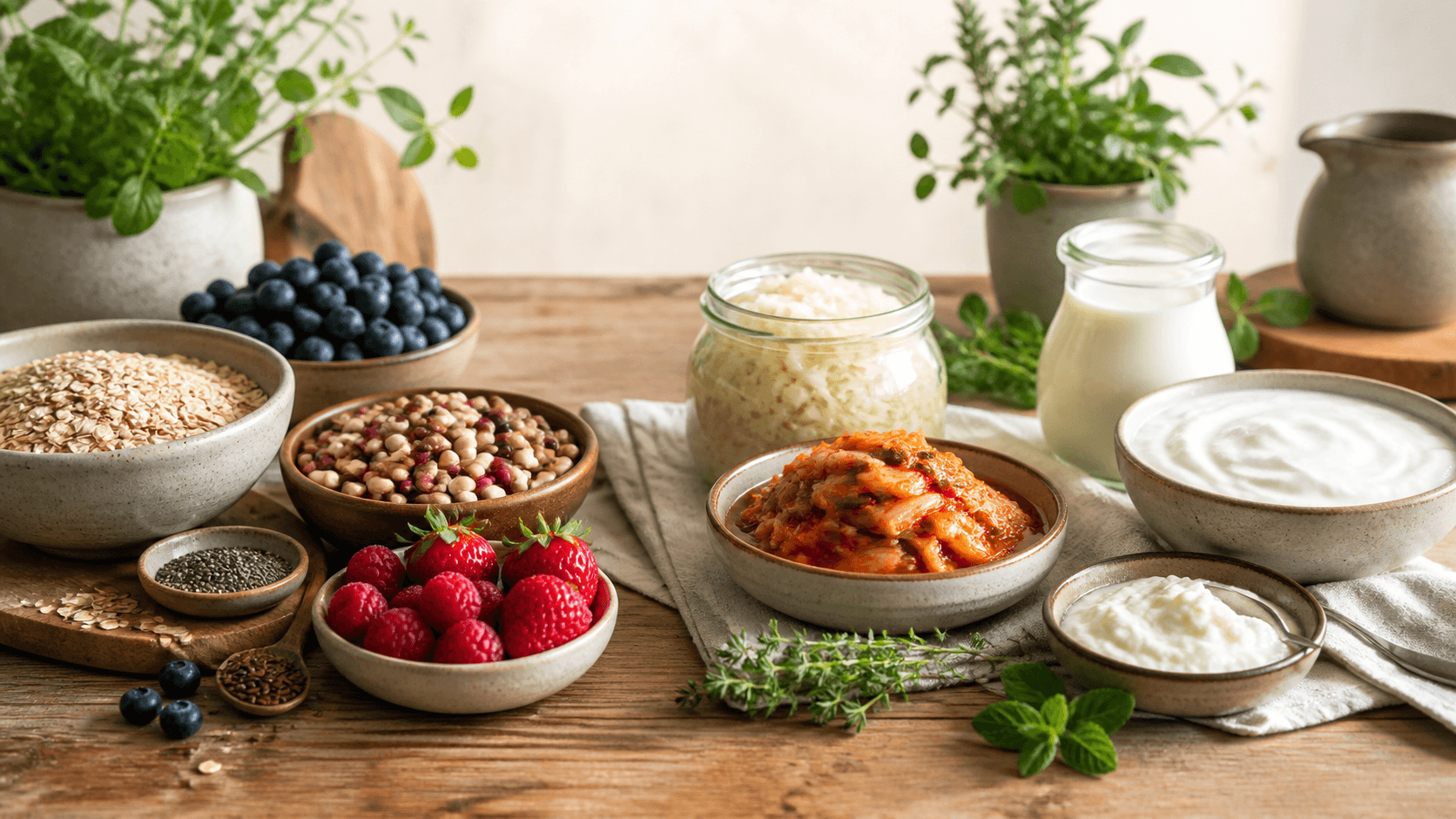
The short answer: for most healthy adults, dietary variety and enough fibre are the first foundations. Fermented foods can add live microbes and diverse food compounds. Probiotic supplements are strain-specific tools, not a universal upgrade. Increase fermentable foods gradually, drink enough fluid and judge outcomes by symptoms and consistency—not by a single “microbiome score.”
Gut health content often presents a shopping ladder: probiotic, prebiotic, synbiotic, test kit. The more useful starting point is simpler. What are you feeding the microbes already living there?
Fibre, prebiotics and probiotics are not the same
| Term | Plain-English meaning | Examples |
|---|---|---|
| Fibre | Carbohydrate components that resist digestion in the small intestine | Whole grains, beans, vegetables, fruit, nuts, seeds |
| Prebiotic | A substrate selectively used by host microorganisms that confers a health benefit | Certain fibres including inulin and fructo-oligosaccharides |
| Probiotic | A live microorganism that provides a health benefit when given in an adequate amount | Specific, identified strains in some foods or supplements |
| Fermented food | Food transformed by microorganisms; it may or may not contain live microbes when eaten | Yoghurt, kefir, kimchi, sauerkraut, tempeh |
Not every fibre is a prebiotic. Not every fermented food is a probiotic. Pasteurisation or cooking may remove live organisms, while the food can still be nutritious.
Start with the fibre gap
UK guidance recommends 30 g of fibre a day for adults, yet the NHS says most adults average roughly 20 g. That ten-gram gap is a more concrete target than chasing the “perfect” microbiome.
Fibre supports bowel function and feeds microbial fermentation. Different plants bring different fibre structures and polyphenols, so variety matters as well as the total. Think oats plus beans plus berries plus greens—not one heroic spoonful of powder.
A recent randomised trial in healthy adults found that added fermentable fibre changed some microbial groups and improved bowel-related quality-of-life measures. Other trials also show an important caution: fermentable fibres can increase bloating in some people. Response is individual.
What do fermented foods add?
Fermentation changes food chemistry and can introduce live cultures. In a 17-week randomised study, a diet high in fermented foods increased microbiome diversity and reduced several inflammatory markers, while the high-fibre arm increased microbial carbohydrate-processing capacity without raising diversity over that time frame.
That study was small—18 people per arm—and does not prove that fermented foods cure inflammatory disease. It does suggest that fibre and fermentation may influence the gut ecosystem through different routes.
Practical options include live yoghurt, kefir, kimchi, sauerkraut and some traditional fermented vegetables. Check salt and added sugar where relevant, and introduce new foods in modest portions.
When do probiotic supplements make sense?
“Probiotic” is not one ingredient. Effects depend on the exact genus, species, strain, dose, outcome and population. Evidence for one strain in one context cannot be transferred to every capsule on the shelf.
Before buying, ask:
- Is the strain fully named, not just “10 billion cultures”?
- Has that strain been studied for my specific goal?
- Is the effective dose supported through the end of shelf life?
- Are storage instructions realistic?
- How long should I trial it, and what outcome will I track?
People who are severely immunocompromised, critically ill or managing significant gastrointestinal disease should seek specialist advice before live-microbe supplements.
How to increase fibre without making bloating worse
Jumping from 15 g to 30 g overnight can be uncomfortable. Use a ramp, not a leap.
Week 1: add one reliable source
Choose one: oats at breakfast, a piece of fruit with nuts, or one extra vegetable serving. Keep fluids steady.
Week 2: add pulses gradually
Start with a small serving of lentils, chickpeas or beans a few times a week. Rinsing canned pulses can improve tolerance for some people.
Week 3: increase variety
Rotate whole grains, fruit colours, vegetables, nuts and seeds. Variety is more useful than forcing a fashionable food you dislike.
Week 4: review symptoms
Track stool frequency and form, bloating, pain and foods—not a vague “detox” feeling. If symptoms worsen, reduce the most recent change and seek advice if problems persist.
People with irritable bowel syndrome, inflammatory bowel disease, coeliac disease, previous bowel surgery or unexplained symptoms may need an individual plan. Restrictive diets such as low-FODMAP should ideally be supervised and followed by structured reintroduction.
Do microbiome tests tell you what to eat?
Commercial stool tests can describe organisms detected in a sample, but the science of turning one snapshot into precise, validated diet or supplement prescriptions is still developing. Results vary with sampling, laboratory methods, recent diet and time.
Be cautious when the same company tests, diagnoses a vague “imbalance” and sells the cure. Symptoms, medical history, diet quality and established clinical tests remain more actionable.
Frequently asked questions
Are fermented foods better than probiotic capsules?
They are different. Fermented foods contribute nutrition and food compounds as well as, in some cases, live cultures. A well-studied probiotic strain may be more targeted for a specific outcome.
What is the best fibre for gut health?
There is no single winner. A range of soluble, insoluble and fermentable fibres from varied foods supports different functions. Tolerance matters.
Can probiotics permanently colonise the gut?
Many supplemented strains are transient. A benefit does not require permanent colonisation, but it also means “more species” on a label is not automatically better.
Why am I bloated after eating more fibre?
Gut microbes ferment some fibres and produce gas. A sudden increase, the fibre type and existing gut sensitivity all matter. Increase gradually and seek clinical advice for severe or persistent symptoms.
The bottom line
The least glamorous gut-health strategy is also the most reusable: varied plants, a gradual route towards adequate fibre, enough fluid and fermented foods you genuinely enjoy. Probiotic supplements can be appropriate, but only when the strain and goal match. Feed the ecosystem before trying to micromanage it.
Related guides
- How to audit your supplement stack — check labels, duplicate nutrients and your reasons for taking each product.
- Magnesium glycinate vs citrate — compare magnesium forms and their practical differences.
- Protein-first on Mounjaro: the nutrient gaps it can miss — a food-variety checklist for readers eating smaller meals during treatment.
Sources: NHS guide to eating more fibre; randomised fibre trial; randomised fermented-food and fibre study; 2026 trial on fibre-related bloating
This article is for general information and does not replace advice from a doctor, pharmacist or registered dietitian.