Published by Norisia Team · 20 September 2026
Two bottles mention urolithin A. One highlights 2,000mg, another 500mg. It looks like a simple strength comparison—until you check what each number actually measures.
A pomegranate-extract weight, a combined blend weight and a declared amount of urolithin A are not interchangeable. A larger front-label number is not enough to show that a product provides more urolithin A, matches a clinical trial or is suitable for you.
This guide focuses on that small but important label-reading problem. It is not a brand ranking, a buying recommendation or a dosing plan.
Why this distinction matters now
Urolithin A is attracting attention around healthy ageing, muscles and the gut microbiome. A recent UK research story added another source of interest: in August 2026, King's College London reported cardiovascular findings in animal models and engineered human heart tissue. These were not clinical treatment results in heart-failure patients. The researchers explicitly cautioned that the findings do not establish pomegranates as a heart-failure treatment. King's College London research announcement.
That distinction matters when a promising headline appears beside a supplement listing. A study about a molecule does not automatically validate every product that mentions the molecule—or a food associated with it.
Is pomegranate extract the same as urolithin A?
No. Pomegranates contain plant compounds, including ellagitannins, that gut microbes can transform through a series of steps into urolithins. Urolithin A is one resulting metabolite. Supplying the precursor compounds is not the same as supplying a measured quantity of that final metabolite.
A 2021 study of 100 healthy adults compared direct urolithin A supplementation with pomegranate juice. Participants varied in their ability to generate urolithin A from the juice; direct supplementation produced more consistent exposure. However, several authors had commercial links to the urolithin A developer. More importantly, the study measured exposure—not proof that a supplement was necessary or delivered superior long-term health. Direct urolithin A versus pomegranate juice study.
The label-reading consequence is straightforward: there is no universal conversion that turns milligrams of pomegranate extract into milligrams of urolithin A your body will produce. Food, extract composition and an individual's microbiome are not a fixed-dose calculator.
Four numbers that can look similar but mean different things
The examples below are hypothetical. They illustrate label interpretation, not an assessment of a named product.
| Label wording | What that number describes | What it does not establish |
|---|---|---|
| “Pomegranate extract: 2,000mg” | The stated extract amount, subject to the label's serving basis | 2,000mg of urolithin A |
| “Longevity blend: 2,000mg” | The combined amount of ingredients in the blend | The amount of each constituent unless separately declared |
| “Urolithin A: 500mg per serving” | A declared quantity of the named molecule per serving | Independent confirmation, personal benefit or authorisation |
| “Equivalent to 2,000mg fruit” | A source-equivalence statement | The actual extract mass or a measured urolithin A dose |
Read the full panel before comparing the largest numbers. An extract standardised to a percentage of ellagic acid or polyphenols still does not become the same ingredient as urolithin A.
The serving-size trap: capsule count is not serving count
Suppose one hypothetical label declares 500mg of urolithin A per two-capsule serving. That means the label declares 250mg per capsule, not 500mg in each. A second product might state its quantities per capsule instead. You cannot compare them until the serving basis matches.
That arithmetic can clarify what is being claimed. It does not tell you which dose to take or establish that the contents match the claim. Follow appropriate professional advice rather than increasing a serving to imitate a trial.
Also distinguish three separate questions:
- Identity: Is the ingredient urolithin A, a precursor extract, or a mixture?
- Quantity: How much of the named ingredient is declared per recommended daily serving?
- Evidence: Was that formulation studied in people like you, for the outcome you care about?
A clear answer to the first two does not automatically answer the third.
What do human trials actually tell us?
A randomised trial in 66 adults aged 65–90 found improvements in some muscle-endurance measures, but not statistically significant differences in its primary six-minute walking-distance and muscle ATP-production outcomes. It was a four-month study, not a demonstration of longer life. 2022 older-adult trial.
A 2026 systematic review assessed five randomised trials involving 236 participants. Only two studies could be pooled for six-minute walking distance; that pooled result was not statistically significant, and the evidence was rated low certainty. Other findings were heterogeneous and exploratory. 2026 systematic review.
This is not the same as saying nothing interesting is happening. It means the evidence supports a narrower discussion than “proven anti-ageing” or “guaranteed energy”. A biomarker, a laboratory mechanism and a noticeable improvement in daily life are different outcomes.
A UK detail many ingredient guides miss: application is not authorisation
Checked on 20 September 2026: the Food Standards Agency/Food Standards Scotland register entry RP-1777, for Amazentis SA's application for urolithin A as a novel food, showed “In progress” at “Risk assessment”. That record did not show a completed authorisation. View the current application record.
This is a statement about that specific application on the date checked—not a blanket legal verdict on every listing, formulation or UK jurisdiction. The register can change. Online availability, a research paper and an application number each tell you something different; none should be casually substituted for the others.
If a seller claims regulatory approval, ask which authority, which ingredient specification, which permitted use and which current record supports the claim. Do not assume a reference to another country's process establishes the position where you live.
Five questions to ask when a label is unclear
Use these as a clarity check, not as a guarantee of safety or effectiveness:
- What exact ingredient does the headline milligram number refer to?
- Is the figure per capsule, per serving or per recommended day?
- Is urolithin A separately quantified, or are only fruit extracts or a total blend listed?
- Is the claimed benefit based on this ingredient and formulation in a human trial, or on precursor foods and laboratory studies?
- What is the current regulatory basis for the exact product and market being discussed?
If those questions cannot be answered, “unclear” is the accurate conclusion. A confident marketing description should not fill in missing information.
For a broader way to record overlapping ingredients and unanswered label questions, see our supplement-stack audit.
Frequently asked questions
Does 2,000mg of pomegranate extract equal 500mg of urolithin A?
No reliable universal equivalence exists. Those are different ingredients, and microbial conversion varies. You cannot infer a urolithin A dose from extract weight alone.
Is urolithin A the same as ellagic acid?
No. Ellagic acid is involved upstream in microbial pathways that can produce urolithins. A declaration of ellagic acid does not establish a declared amount of urolithin A.
Does a higher milligram number mean a better supplement?
Not by itself. First identify the substance and serving basis. Even a correctly declared larger amount does not demonstrate greater benefit, suitability or safety.
Can pomegranate juice replace urolithin A used in a study?
It is not a dose-matched substitute. That does not make pomegranates nutritionally inferior: fruit is food, not an attempt to reproduce a capsule trial. Our guide to fibre, fermented foods and probiotics explores a broader food-first view of gut health.
Does an FSA application number mean a product is approved?
An application number identifies a regulatory application. Check its status and scope rather than treating the number itself as an approval badge.
The takeaway
Before asking “How many milligrams?”, ask “Milligrams of what, in which serving, supported by which evidence?” That question separates a genuine ingredient comparison from a comparison of impressive-looking numbers.
Educational information, not personal medical or legal advice. Evidence and the cited application status checked on 20 September 2026. Do not use a supplement or pomegranate product to replace treatment for heart disease or another medical condition. Discuss new supplements with a pharmacist or clinician if you take medicines, have a health condition, are pregnant or are breastfeeding.
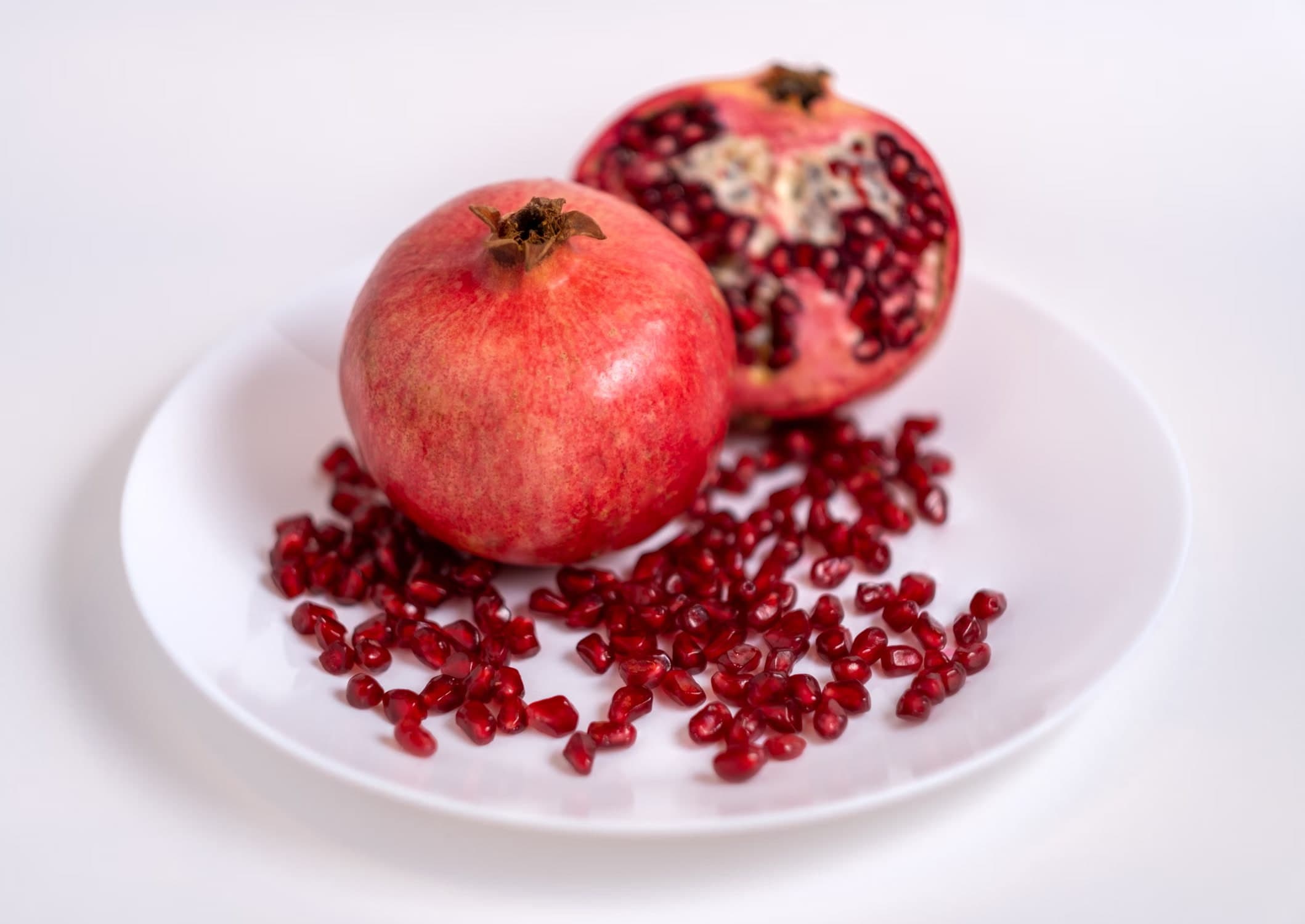
Photo: Yevgen Buzuk / Pexels, used under the Pexels licence. Pomegranates illustrate the precursor-food connection; the photograph does not imply a measured urolithin A content or a treatment benefit.